What’s in this guide
Selecting the right mesh count is essential for achieving the desired ink transfer, detail, and longevity in screen printing. This guide compares common mesh counts, explains how to match them to ink type and artwork, and highlights five reliable screen printing frames and meshes available on Amazon. Whether you’re printing textiles, posters, or crafts, understanding mesh count helps optimize throughput and image sharpness while avoiding ink smearing or premature wear.
| Product | Mesh Count | Type |
|---|---|---|
| GoldUpUSAInc 20 x 24 Inch Frames (2 Pack) | 160 | Aluminum frame, white mesh |
| VEVOR Screen Printing Kit (2 Pieces) | 160 | Aluminum frame, nylon mesh |
| Caydo 4 Pieces Large Dry Sift Set | 110 / 160 / 230 / 305 | Aluminum frame set, mixed mesh |
| GoldUpUSAInc 20 x 24 Inch Frames (6 Pack) | 110 | Aluminum frame, white mesh |
| MS WGO Silk Screen Fabric Mesh (3 Yards) | 100 | Polyester mesh |
Best 160-Mesh Frames For High-Detail Printing

GoldUpUSAInc offers 20 x 24 inch pre-stretched aluminum frames with 160 counts of white mesh. The frame dimensions are 20″ x 24″ outside, with an internal work area of 17.2″ x 21.2″. The mesh is white and designed for solid detail transfer, with a tension range of 20–24 N/cm. This setup is suitable for mid-to-high detail screen prints on textiles and flat substrates, where ink coverage and edge clarity matter. The dual-pack option is convenient for multi-color workflows or backup frames during production.
VEVOR Kit: 160-Mesh Frames For DIY Projects

The VEVOR kit includes two 20×24 inch aluminum frames with 160-count nylon mesh. The frames feature laser-welded construction for stability under repeated use and a glossy, evenly distributed high-tension mesh designed to penetrate ink with ease. The kit’s sealing and assembly emphasize edge ink control, reducing leakage at frame borders. This option suits hobbyists and small shops seeking reliable, scalable printing capabilities without compromising frame integrity.
Caydo Four-Mome Large Mesh Sets: 110–305
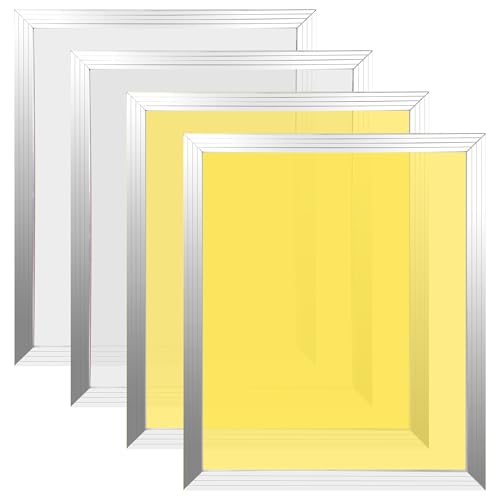
The Caydo set provides four frames with varying mesh counts: 110 (white), 160 (white), 230, and 305 (yellow). This range enables quick adaptation to different inks and artwork—low counts for faster ink flow on bold designs, higher counts for fine detail and halftones. The frames are aluminum, durable, and the mesh surfaces are sandblasted with solvent-resistant glue to prevent mesh delamination. This versatility makes Caydo an attractive choice for mixed-media screen printing.
Six-Pack Of 110-Mesh Frames For Speed

This six-pack variation from GoldUpUSAInc uses 110-count white mesh, offering larger holes for rapid ink passage suitable for simpler designs and high-volume runs. The frames maintain robust outer dimensions (20″ x 24″) with an interior work area identical to the 160-mesh option. The 6-pack arrangement supports batch production and training environments, letting teams switch between frames without downtime.
MS WGO 3 Yards Of 100-Mesh Silk Screen Fabric

MS WGO’s 3-yard roll provides 100-mesh white silk screen fabric. Suitable for broad coverage and forgiving detail, this mesh is well-suited to basic graphics and large areas of color. It’s described as using high-quality polyester filaments with good stability and even mesh formation, offering reliable performance at an economical price point for entry-level projects.
Buying Guide: Key Mesh Considerations And Practical Comparisons
When choosing mesh for screen printing, consider these factors:
- Artwork detail: Higher mesh counts (160–305) yield intricate lines and fine halftones but reduce ink flow. Lower counts (110–160) pass more ink, improving brightness for bold designs but may blur fine details.
- Ink type and substrate: Water-based inks on textiles often benefit from mid-to-high mesh counts to balance coverage and brightness, while solvent-based inks on hard surfaces may tolerate higher counts for precision.
- Print speed vs. precision: Low counts enable faster printing with more ink, while high counts provide sharper detail but slower ink deposition and longer exposure times in some setups.
- Frame quality and tension: Durable aluminum frames with high-tension mesh reduce warping and edge leakage. Look for laser-welded frames and tight mesh tension specifications.
- Maintenance and longevity: Mesh surfaces with sandblasted finishes and solvent-resistant glue resist delamination and prolong frame life, especially under frequent use and cleaning cycles.
Product mix considerations:
- For high-detail work like fine typography or photographic reproductions, prioritize 160–230 mesh counts with robust frames.
- For bold, solid color blocks or large graphics, 110–160 mesh can maximize ink transfer and reduce print times.
- A mixed-mesh kit (as with Caydo) supports a broad project range from simple to detailed, reducing the need to swap frames mid-run.
Practical workflow notes:
- Plan for frame storage and rotation to prevent frame fatigue. Rotate between frames with different mesh counts to distribute wear evenly.
- Keep ink viscosity appropriate for the mesh count in use. Overly thick inks can hinder deposition through high-count meshes, while too-thin inks may bleed on low-count meshes.
- Test prints are essential. Use a small run test to verify line sharpness, edge leakage, and ink coverage before scaling up production.