Finding the right bed adhesion solution is essential for producing smooth first layers, minimizing warping, and ensuring prints stay put on heated build surfaces. This guide rounds up top bed adhesives designed for PLA, ABS, PETG, and other common filaments. Each option below highlights application ease, compatibility, and how it helps prevent print failures. Use the quick summary table to compare key details at a glance.
| Product | |||
|---|---|---|---|
| 3DLAC 3D Printing Adhesive | 3DLAC | 400 ml | Firm adhesion with quick release on glass, PEI, Kapton and build plates |
| ENOMAKER Bamboo Lab 3D Printer Bed Adhesive | ENOMAKER | 60 ml | Strong adhesion, easy release, minimal residue |
| TEQStone 3D Printer Glue Stick | TEQStone | 36 g | Improved adhesion across surfaces, safe materials |
| Vision Miner Nano Polymer Adhesive | Vision Miner | 50 ml | Universal compatibility, non-toxic, easy cleanup |
| Anycubic 3D Printer Bed Adhesive Glue | ANYCUBIC | 60 ml (2 pcs) | Strong adhesion with easy cleaning, broad filament compatibility |
The following sections provide concise product overviews, practical use cases, and objective considerations to help you choose the best bed adhesive for your setup.
3DLAC 3D Printing Adhesive For Heated Beds

The 3DLAC Spray forms a film that strongly adheres prints to various bed surfaces, yet releases quickly when cooling. It acts as a substitute for Kapton tape, blue tape, and similar surface treatments, making it suitable for glass, PEI, BuildTak, Kapton, and other common beds. It supports a broad range of filaments, including PLA, ABS, PETG, HIPS, and carbon fiber composites. Users can achieve reliable first layers and reduce print failures due to bed detachment, particularly on stubborn geometries or flexible surfaces.
ENOMAKER Bamboo Lab Bed Adhesive

ENOMAKER’s bed adhesive is formulated to prevent warping and deliver consistent first-layer adhesion across materials like ABS, PLA, PETG, and TPU. The product is designed for durability and ease of use, with a focus on minimal residue after prints. A small amount is enough for multiple cycles, and reapplication before each printing session is recommended for optimal results. This option is particularly suited to high-speed printing where bed reliability is critical and print success rates matter for productivity.
TEQStone 3D Printer Glue Stick

TEQStone JT16 glue sticks provide enhanced adhesion on a variety of bed surfaces, including PEI, glass, and aluminum. They are designed to curb warping for ABS, PLA, and PETG, while offering easier print removal. The material safety profile emphasizes a safe composition suitable for home environments, classrooms, or offices. Glue sticks are a familiar, low-wuss option for users who want predictable performance without complex preparation or cleanup.
Vision Miner Nano Polymer Bed Adhesive

Vision Miner’s Nano Polymer Adhesive focuses on universal compatibility across filaments like PLA, ABS, PETG, PEEK, Nylon, PC, and more. It supports a wide range of build surfaces—from borosilicate glass to PEI and BuildTak—helping eliminate warping and lifting even with large or high-performance filaments. The formula is designed to be non-toxic and easy to apply, with straightforward cleanup after cooling. This option suits users seeking a single, flexible solution for varied projects and bed types.
Limino 3D Printer Glue Spray
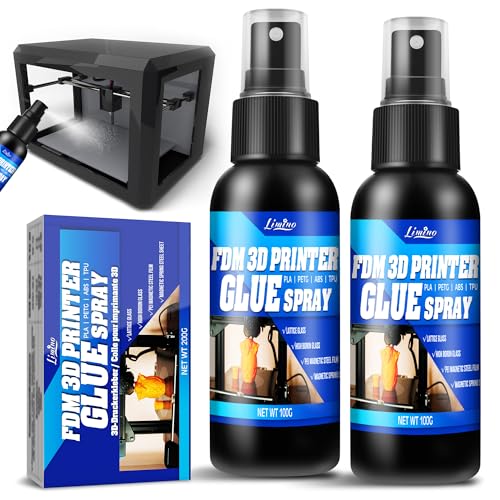
Limino’s dual 3.5 oz bottles provide an economical option for large-scale or frequent printing. The spray format enables even coverage with a light mist, reducing the effort required for consistent adhesion. It is compatible with PLA, ABS, PETG, TPU, and other common filaments on various bed surfaces such as glass, PEI, BuildTak, or Kapton. The product emphasizes easy application, strong first-layer bonding, and straightforward removal after printing, making it a practical choice for hobbyists and makers who print often.
Buying Guide: Key Considerations For Bed Adhesion
- Filament compatibility: Some adhesives excel with a broad spectrum of materials (PLA, ABS, PETG, TPU, nylon, PEEK, etc.). If you switch filaments frequently, prioritize universal adhesion products.
- Bed surface compatibility: Adhesives perform differently on glass, PEI, BuildTak, Kapton, and other surfaces. Confirm the product notes align with your printer’s bed.
- Application method: Sprays, sticks, and liquids vary in ease of use and cleanup. Sprays need even coverage and can leave residues if overapplied; sticks require brushing on with care; liquids often need curing time.
- Removability and residue: Choose products that release cleanly after cooling and leave minimal residue, reducing post-processing effort and wear on build surfaces.
- Odor and safety: For homes, classrooms, or offices, odorless or low-odor formulas are preferable. Look for non-toxic ingredients and clear safety instructions.
- Reapplication cadence: Some adhesives perform best when reapplied between prints, while others sustain adhesion across multiple parts. Consider your typical print count per session.
- Cost per use: Compare volume and coverage. Larger volumes may reduce per-print cost, but require proper storage to prevent drying out.
- Cleanup requirements: Water-soluble or easy-wipe formulations cut down post-processing time and reduce risk to delicate surfaces.
- Environmental considerations: If you print in shared or sensitive spaces, opt for low-odour, non-flammable options and ensure storage away from heat sources.
- Special use-cases: For high-warp filament like ABS or high-speed prints, prioritize adhesives offering strong initial grip and reliable release without lifting.
When selecting a bed adhesive, balance adhesion strength with ease of use and maintenance. A versatile option with broad filament compatibility often serves as a dependable default, while specialty formulations can optimize performance for specific materials or bed surfaces. For mixed-material projects, a combination of a universal spray or liquid and a dedicated glue stick can cover most scenarios without overloading the printer bed with residues.